ENERGY → COMPUTE → INTELLIGENCE

Before you commit more capital, know what the evidence actually supports.

Technical pre-diligence and decision support for consequential Texas energy and infrastructure decisions.

We bring well, lease and production records together, name the sources and keep missing evidence visible.

Texas Asset Research

Have an API number? Start here.

Search by Texas API number or browse the county inventory. Examine the dated source records and what they can — and cannot — establish.

Search the public records ↗

Free public records, an interactive coverage map and planned research regions, together in Asset Research. No account or payment required.

Explore coverage and planned regions →
ZAI Digital Office

A place for every part of the work.

Choose a room to explore our work. Each room shows its status; dashed outlines mark areas in preparation or planned.

Conceptual office map · not to scaleSelect a room
RESEARCHENGINEERINGFIELD CONCEPTCORRIDORA map of our work · not a physical floor planENTRANCEResearch Room● WORKINGEngineering Desk● WORKINGZAI-750 Bay● IN PREPARATIONREFERENCE CONCEPTFuture expansion● OPERATOR TOOLS · LATERPartner Bay● RESERVEDReception● WORKING
Research & engineering

From scattered records to a clear picture.

Sources connected. Claims checked. Open questions kept visible.

Find the evidence

Start with the asset and its dated records.

Test the claim

Separate what is supported from what is still unknown.

Make the next step clear

Bring findings, limitations and next evidence requests together.

Explore our evidence method
Asset intelligence

Know what the evidence actually supports.

ZAI Asset Intelligence organizes fragmented technical, regulatory, public and provided asset evidence into structured, auditable decision support.

The objective is not to manufacture certainty. It is to expose provenance, separate knowns from unknowns, test material claims and produce a bounded body of work that can be reviewed.

Evidence inventory

What exists, what is missing and where it came from.

Claim validation

What the available evidence can and cannot establish.

Decision support

Structured findings with limitations kept visible.

Auditable package

A reviewable deliverable rather than an opaque conclusion.

Evidence-governed workflow

From source material to governed output.

  1. 01

    Evidence

    Begin with bounded source material, not assumptions.

  2. 02

    Provenance

    Preserve where information came from and what it can support.

  3. 03

    Validation

    Test claims against explicit technical and evidentiary boundaries.

  4. 04

    Engineering Reasoning

    Turn validated evidence into structured technical understanding.

  5. 05

    Human Authority

    Keep consequential judgment and release authority with accountable people.

  6. 06

    Governed Output

    Deliver reviewable work with its evidence and limitations intact.

Engineering intelligence

Engineering reasoning with an evidence boundary.

Engineering Intelligence connects systems thinking, validation architecture and traceable evidence without turning inference into fact.

  • Systems architecture and technical decomposition
  • Evidence-governed validation architecture
  • Explicit assumptions, limitations and unresolved unknowns
  • Human review before governed release
Open an example evidence ledger
  1. Agree the questionOne asset or a short well list, the question to answer and a delivery date.
  2. Reconcile the recordsWell, lease and production references matched across sources.
  3. Mark the evidenceEach value is confirmed, reported, conflicting or missing.
  4. Deliver in writingA concise assessment with source links and open questions.
Example evidence ledgerFictional example · format only
Illustrative evidence ledger: fictional records and example statuses, not findings about a real well.
ItemValueSourceStatus
Well identityExample Unit 12 #1HState well recordConfirmed
CountyExample county, TexasState well recordConfirmed
Lease referenceTwo lease numbers in useWell record vs. production reportConflict
Last reported gasMonthly volume, datedProduction reportReported
Flaring or ventingReported in some monthsOperator filingsReported
Gas compositionNot found in reviewed recordsNone found in this exampleMissing
Wellhead pressureNot found in reviewed recordsNone found in this exampleMissing

The source labels and statuses above are fictional examples of the format. Reported historical production does not establish gas available for a new project. Supply, access, gas quality and operating rights need direct confirmation.

Services & pricing · fixed-fee engagements

Scope first. Price second. Engagement third.

Bring the asset and the question. We agree the scope before an engagement begins.

Choose the work your team needs: establish the evidence, answer one agreed question, or reconcile an integrated dossier. The fee reflects that scope and review responsibility.

Fixed fee · USD 1,750

Asset Evidence Review

“What do we actually know about this asset?”

For an asset team establishing a reliable starting point before commissioning more research.

You receive
An asset identity and source register, a dated records inventory, a discrepancy and gap register, and specific next records requests.

What is included

Starting inputs
One agreed asset, the review period and the permitted, accessible records.

Work performed
Match asset identifiers across records, preserve source dates, reconcile reported facts and expose missing or conflicting evidence.

Example of the work
A lease production total and a well record refer to different reporting units. The review makes that distinction explicit before the total is attributed to a well.

Handoff to your team
Use the reviewed evidence register in your asset file and assign the unresolved records requests to your research team.

Public evidence demonstrations

AVA STATE 36 — Featured Evidence Review
Dated public-record reconciliation, reported gas disposition and clearly documented unknowns.

Read AVA Asset Evidence Review (PDF, 9 pages) (opens in new tab)↗
Read AVA Evidence Annex (PDF, 7 pages) (opens in new tab)↗

PECAN 47 — earlier public demonstration (PDF, 7 pages) (opens in new tab)↗

Both are self-commissioned public-record examples, not commissioned or endorsed by the named operators.

Ask about this review →
Fixed fee · USD 3,500

Engineering Intelligence Assessment

“What do the reviewed records support about one agreed question?”

For an asset or research team that needs an evidence-supported answer to a defined question.

You receive
A question-specific findings memo, source-linked analysis, reproducible calculations where applicable, limitations and next research steps.

What is included

Starting inputs
One agreed asset, one accepted research question, source coverage and a defined period.

Work performed
Build the relevant comparisons and calculations, examine supporting and conflicting records, and explain what the evidence can and cannot answer.

Example of the work
How did reported gas change between two defined six-month periods? Separate total-volume change from daily-average change and distinguish reported production from available fuel.

Handoff to your team
Attach the findings and their supporting evidence to your existing research review; retain the unanswered questions alongside the conclusion.

Ask about this assessment →
Fixed fee · USD 6,500

Asset Evidence & Technical Assessment

“How do the asset records, findings and unresolved dependencies fit together?”

For a team handing a coherent asset evidence dossier between research, technical review and further document collection.

You receive
An integrated reviewed dossier with evidence-linked findings, reconciliation and coverage records, unresolved dependencies and specific next research requests.

What is included

Starting inputs
The agreed asset dossier, sources and periods, plus any accepted research questions and deliverable sections.

Work performed
Integrate identity, dated records and analysis; reconcile cross-source conflicts; connect findings to their evidence and unresolved dependencies.

Example of the work
Production history, a permit record and a gas analysis cover different subjects or dates. The dossier shows which findings remain supported and which require new evidence.

Handoff to your team
Give the receiving team one versioned dossier that preserves source references, open dependencies and the reasoning behind each finding.

Ask about this assessment →
CAPITAN · methodology reference

The evidence led us there.

A record mismatch resolved. A production claim bounded. The missing field evidence made explicit.

Read the CAPITAN reference case →

Methodology reference only. CAPITAN did not commission, purchase, endorse, approve or certify ZAI’s services.

Private Digital Office · in development

Keep the work connected.

One engagement. Its evidence. Its review. Its controlled release.

ENGAGEMENTEVIDENCEREVIEWRELEASE

In active development; not an open self-service customer portal.

About the Private Digital Office
Private Digital Office

The work should remain connected to its evidence.

In development

The ZAI Private Digital Office is the governed product boundary for structured engagements, evidence and reviewable outputs.

Begin here with free public-record research or a scope request. A scope check identifies the service boundary; it is not a technical approval of your asset. For accepted work, evidence preparation, human review and controlled report delivery follow.

The Private Digital Office is a separate application surface in active development, not an open self-service customer portal.

ENGAGEMENTEVIDENCEREVIEWRELEASE
Begin with a scope request →
Enter the Private Digital Office →
ZAI-750 · a concept by ZAI Digital Infrastructure

Energy at the source. Compute on site.

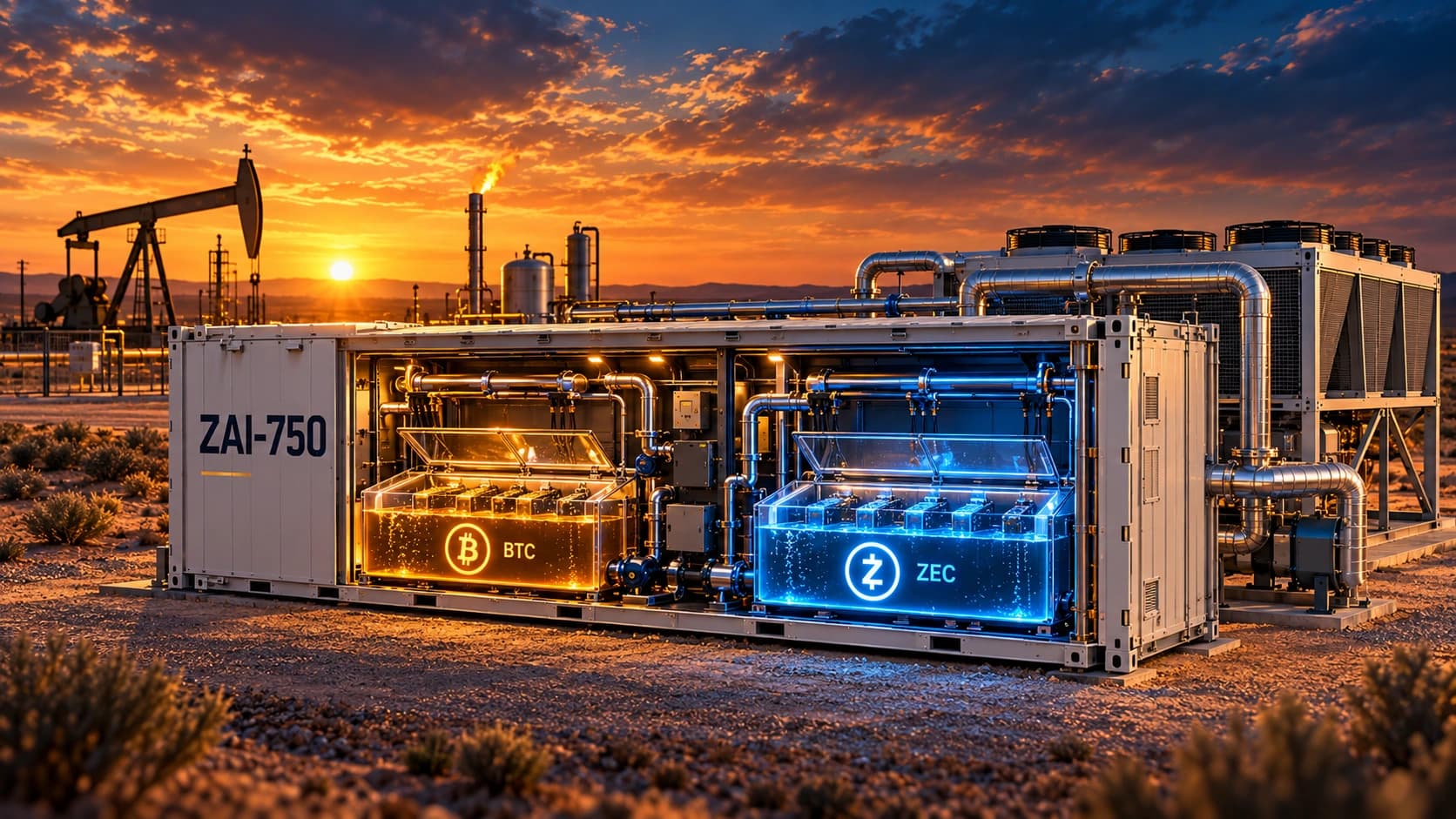
Immersion-cooled mining.Bitcoin and Zcash, designed together.

ZAI-750 concept cutaway at a Permian gas site: gold Bitcoin and blue Zcash immersion tanks, visible piping and an external heat-rejection unit.

ZAI-750 concept visualisation · BTC + ZEC immersion cooling · not an installed site or a validated equipment design.

One ZAI concept · two mining streams

Immersion cooling at the core.

Mining hardware immersed in dielectric fluid, with heat carried to an external cooling loop.

BTCBitcoin
50%concept target
ZECZcash
50%concept target

Target concept balance. The allocation basis and final equipment sizing will be defined in engineering.

Start with the gas — and the evidence.

Flow, composition, pressure, access and gas-use rights need direct confirmation. Historical production alone does not establish a usable supply.

Pilot planned · site qualification requiredDiscuss the technical role →
Environmental design approach

Use energy carefully.
Make the result measurable.

Energy at its source, immersion at the hardware, and evidence behind every environmental claim.

Evaluate gas at its source.

Identify whether gas otherwise flared or vented could support useful on-site generation. Supply, rights and the existing emissions baseline need site evidence.

Carry heat in a cooling loop.

Dielectric fluid takes heat from the mining hardware to an external cooling system. Pumps, heat rejection and fluid management are part of the design.

Measure the full system.

Compare the site baseline with generator emissions, methane leakage and total energy use. Record water use and cooling-fluid handling before claiming a benefit.

These are design objectives, not measured ZAI-750 outcomes. Immersion cooling alone does not establish a lower environmental impact; any claim requires a defined comparison and site measurements.

Design references & evidence boundary

U.S. DOE · Energy-efficient data center design and U.S. EPA · Methane emissions from the oil and gas sector. Accessed October 8, 2026. General design and measurement resources; neither verifies this ZAI concept, endorses it, nor establishes its environmental performance.

Engineering basis & pilot acceptance

Power budget

498.3 kWReference ASIC load
183.5 kWRemaining within cap¹
68.2 kWDesign margin

¹ Shared by cooling, other auxiliaries and any tuning. Performance and power draw must be measured together.

Operating cap
681.8 kW incl. auxiliaries (750 / 1.10)
Earlier reference fleet
110 × Z15 Pro + 55 × S21 (200 TH/s); sizing reference, not proof of a 50/50 split
Dual-mining target
50% BTC / 50% ZEC concept balance. Whether this is allocated by power, physical space or another agreed capacity measure must be defined before equipment sizing.
Cooling concept
Immersion cooling; fluid, compatible hardware, pumps and heat rejection sized together
Energy-cost target
Below USD 0.02/kWh, including fuel, generation, maintenance and auxiliaries; subject to site costing

The 498.3 kW figure describes the earlier reference fleet; it does not validate the new 50/50 allocation target. Final immersion-compatible equipment, layout and loads require engineering validation within the operating cap. BTC and ZEC performance are measured separately; this target does not establish equal power consumption, machine counts or returns. No ZAI-750 installation is operating yet.

How a pilot gets built

  1. Step 1
    Qualify the siteConfirm gas flow, composition and pressure through site evidence; confirm access, rights and applicable approvals.
  2. Step 2
    Design togetherBTC and ZEC fleet allocation, immersion cooling and auxiliaries sized as one system within the 681.8 kW cap.
  3. Step 3
    Accept on evidenceSafety, metered complete load and pool-accepted work checked against agreed tests.
  4. Step 4
    Repeat what worksPilot results decide the next sites and refine the design.
Trust architecture

Governance is part of the product.

  • Evidence has identity.
  • UNKNOWN is a valid result.
  • Missing evidence is not converted into certainty.
  • Human judgment remains explicit.
  • Released work products are controlled technical records.

AI is an execution capability within the methodology. It is not the source of professional authority.

AI systems are tools. Human judgment directs.

From the office

Work in progress. Evidence on record.

The latest dated research and design notes, with their source boundaries.

Read the November 3, 2026 publication update
  1. AVA STATE 36 — Asset Evidence Review PublishedZAI Digital Infrastructure has published a self-commissioned public-record demonstration for AVA STATE 36 in Reeves County, Texas. The review reconciles dated regulatory records, identifies material reporting changes, and distinguishes documented findings from unresolved physical and commercial questions.

    The complete 9-page Asset Evidence Review and its 7-page Evidence Annex are now publicly available.

    Read the Report (PDF) ↗ · Evidence Annex (PDF) ↗

    Self-commissioned public-record demonstration. No operator affiliation or endorsement is implied. Not a site-qualification determination.

Read the October 8, 2026 updates
  1. Six-county research, with a dated recordThe daily research brief reports 87,136 source API identifiers and 12,447 research candidates. The latest included production month is July 2026; no candidate changes were reported against the previous comparison.

    Source: ZAI-750 daily research brief, run 20261008001706-04a6be0dbb4f. This is a dated snapshot, not a live counter. Research candidates are not qualified sites.

  2. A defined power budget for ZAI-750The reference design uses a 750 kW envelope and a 681.8 kW total operating cap, including auxiliaries. Site qualification and engineering validation remain ahead.

    Source: ZAI-750 reference design basis, October 8, 2026. Design basis only; no field-performance claim.

Reception · Bring Your Asset

You don’t need the perfect question.
Just tell us what you need to decide.

Start with the asset name or public reference and the decision ahead. We’ll confirm the appropriate service scope and price before any engagement. Please don’t send confidential documents. Email is our preferred starting point.

Open the scope form →

Use the scope form below, or send your question by email.

Please do not send confidential documents or information. We cannot accept non-public material at this stage. If your request would need it, tell us that first, without sending it, and we will reply in writing whether and how we can proceed.

contact@zai.energy

A useful first message includes

  • The well, lease or area, with any API or lease numbers you have
  • The question you want answered
  • Links to relevant publicly available records
  • When you need an answer

Where things stand

Status snapshot · October 8, 2026

Written enquiries and asset questionsWorking
Public-record research, six countiesWorking
Paid research servicesIn preparation
ZAI-750 first pilotIn preparation
Operator toolsPlanned
Bring Your Asset

Start with your asset and question.

Scope determination precedes any engagement. Live checkout remains on hold.

We consider enquiries across Texas. Our initial public-record research area covers Reeves, Loving, Ward, Martin, Midland and Upton counties in Texas. We confirm the evidence available for your asset, the deliverables and the delivery date before accepting an engagement.

Please do not send confidential documents or information. We cannot accept non-public material at this stage. If your request would need it, tell us that first, without sending it, and we will reply in writing whether and how we can proceed.

You
Service
Asset

Provide what you know. You do not need every identifier — if some are missing, ZAI will determine whether an individual scope review is needed. This review clarifies the work and fee for your selected service; it is not a separate service.

Does this request involve more than one asset?
Decision

Tell us your purpose. This context does not by itself define the work ZAI accepts or imply that ZAI will evaluate or endorse your decision.

Technical question

Optional for this service. The number of questions here is not what determines scope. For the combined dossier, no separate question means reviewing the agreed asset records, source comparisons and gaps, not evaluating your decision.

Evidence

Tell us only whether additional evidence is needed. Do not paste or attach its contents.

Does this request need evidence beyond publicly available regulatory records (for example, private engineering reports, proprietary production data, or vendor material)?